
How to Start a Blog for Beginner: The Complete 2
Do you want to learn how to start a blog?
If you want to start a blog but feel overwhelmed, you’re not alone. Blogging is a great way to start sharing your ideas, building an audience, or even making money online. With so much information out there, it’s easy to get lost. That’s why we’ve put together this simple, step-by-step guide to help beginners start a blog in 2025—quickly and easily. No fluff, just the essentials you need to launch with confidence!
FirstSiteGuide is a free resource that is 100% supported by readers.
Disclosure: If you purchase products through links on our site (i.e. Bluehost services), we may earn a commission. It comes at no extra cost to you, but it supports us in creating more useful content.
More than twenty thousand people have started their blogs using this free guide.
This in-depth guide is 8400 words. I share everything new bloggers should know for starting a blog in 2024. You can take your time and read at your own pace!
 Short on Time? → Click Here for a Quick Start with Bluehost
If you want to skip the intro and just learn how to build a WordPress blog with one-click install, use the link below:
Jump to Step #4: Start a blog by setting up WordPress software
P.S. If you have any questions about this guide or get stuck with the steps, I am more than happy to assist you. You can get in touch with me and ask for free advice.
Kind words from top bloggers and influencers:
“If you’re just starting a blog or want to level up your skills, make sure to check out @firstsiteguide.”

“Blogging guide for beginners via @firstsiteguide. Super helpful!”

“New to #blogging or looking for additional blogging resources? Check out @FirstSiteGuide.”

How to Start a Blog in 9 Exact Steps
Here is the table of contents. This guide covers a lot of useful information, but don’t get overwhelmed, go through each step and you will succeed in blogging.
- Step #1: Pick a niche (topic) for your blog
- Step #2: Choose a blogging platform
- Step #3: Choose a domain name and get blog hosting
- Step #4: Start a blog by setting up WordPress
- Step #5: Select a theme and design your blog
- Step #6: Write and publish blog content
- Step #7: Optimize your blog for search engines
- Step #8: Promote, market, and grow your blog
- Step #9: Make money blogging (optional)
Before you move into action, here are some valuable facts about why you should start a blog.
Think about why you are starting a blog
Do you want to communicate something, like a message or an idea? Do you want to build a community around a topic you enjoy?
A blog can help you to accomplish many things, such as: inform, educate, promote and even sell.
Here are some reasons why many people create a blog and enjoy blogging:
- To use it as an outlet for creative expression.
- To establish expertise and build an audience.
- To network with others and grow a business.
- To enhance writing and thinking skills.
- To become self-employed or make more money.
Blogging has a lot of benefits, and for some people, it can be a great way to earn extra income online.
A quick primer – Blogging for beginners
All in all, there are four important steps to understanding “how to make a blog” quickly. If you are familiar with these things, you can set up a blog in 15-20 minutes or even less:
- Pick a blogging niche (topic)
- Select the best blog platform
- Get a domain and web hosting
- Install WordPress software
Creating a blog is your first step in entering the blogging world. However, to be successful online you have to learn more. There are more than 100 free guides and resources on FirstSiteGuide to help you to succeed on the web!
Step #1: Pick A Niche For Your Blog
Choosing the right niche is the first big step when you create your first blog. A niche defines what you’ll write about and helps attract the right audience. To make blogging enjoyable and sustainable, start by listing topics that excite you—whether it’s a personal passion or a professional skill.
Think about hobbies you love, skills you want to share, or even things you’re eager to learn. For example, if you enjoy photography, coding, or cooking, these could be great niche ideas. The key is to pick something you won’t get tired of writing about.
There are many reasons to start a blog, but having a clear niche makes it easier to grow and monetize. Whether you want to blog online for fun or build a business, choosing the right topic sets the foundation for success.
Step #2: Choose a blogging platform
At this stage, you’ll need to look at the currently available blogging platforms and determine the type of blog management software you will use.
When it comes to blogging sites, you have a few options. Below are usage statistics showing the distribution of blog technologies in the United States.
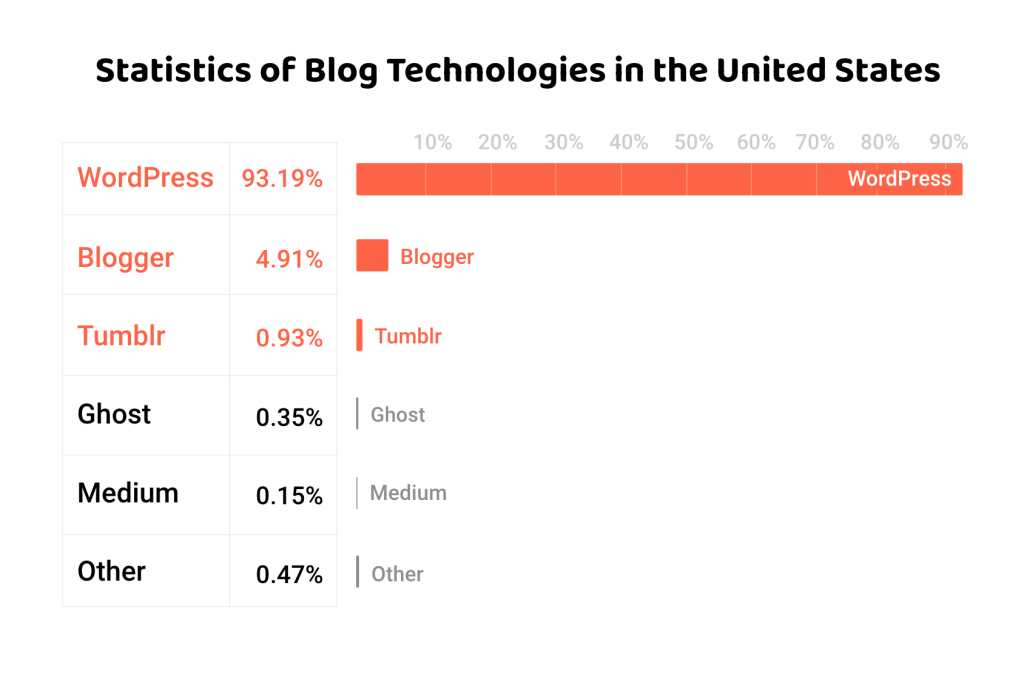
As you can see from the graph, WordPress software is by far the most popular technology for blogging, with over 90% market share in the U.S.
I recommend building your blog using the self-hosted WordPress blog setup that I share in this guide.
You will set up your blog using a custom domain name and web hosting (I’ll show you how in the next step).
That way, you will completely control your blog and its contents. It will cost just a few dollars per month for the webspace (hosting account) and around ten dollars per year for a domain. The actual blogging software is free and open source.
What About Free Blogging Sites?
For many new bloggers, it’s tempting to start a blog using free-hosted platforms such as Blogger or Tumblr.
However, it’s important to understand that “free” always comes with limitations:
- First, your blog name will be set as a subdomain
- Second, you’ll be subject to their rules and restrictions.
Free options come in handy for testing a blogging platform. But if you’re serious about starting a blog, you’ll have to start paying for full services and a custom domain name sooner or later.
Step #3: Choose A Domain Name And Get Blog Hosting
To make your blog using WordPress.org, you need two important things: a domain name and a web hosting company.
Domain Name
Your domain name will be the name by which you will be known online, no matter what niche you choose. It’s your blog’s unique address on the Internet.
Here’s what you should consider when choosing a blog name:
- It should be short and catchy, easy to pronounce and type.
- You can also use combinations of your first and last names.
The general rule is to choose a widely recognized domain extension, but other options can work too. The key is to be memorable—if a unique extension helps you stand out, don’t be afraid to break the rules!
Have a name idea for your blog? Use this quick domain search tool powered by Bluehost – our recommended web hosting provider (I’ll explain why in a moment).
If you can’t find a domain name you like, don’t worry. Bluehost lets you choose a Free custom domain later before your blog goes live. That will give you time to do some thinking and research.
Web Hosting
After choosing a domain name, selecting a reliable hosting service will be one of your most important decisions.
To a great extent, the functionality and performance of your blog will depend on your hosting provider. The host makes sure that your blog is available 24/7 to potential readers and it’s where your content is stored online.
If you are a new blogger, I suggest using Bluehost hosting.
Here is why you should be confident going with this company:
- Ease-of-use: With Bluehost, you will be able to set up your blog with a few clicks of a button.
- Good value: You get reliable service with excellent customer support at an affordable price.
- Room to grow: They offer a great set of features that you need to start, run, and grow your blog.
- Security: Free SSL certificate included and pre-installed to keep your blog visitors data safe.
- Verified provider: Bluehost is a recommended hosting provider on the official WordPress.org website.
- Used by many: I use their services, as do many blogger friends and family members.
- Survey winner: Based on our research, Bluehost is a top choice in the opinion of many blogging experts.

How much does it cost to start a blog?
Below are the costs of a 1-year Bluehost basic hosting plan and what extras you get with it. I was able to negotiate a special deal only for our visitors. Use this link to get an exclusive 67% discount.
| WordPress.org + Bluehost | |
| Blog hosting service | $2.95 per month (billed for 1 year) |
| Domain registration | First-year free (after $19.99 per year) |
| Custom email | Free Web-Based E-mails/ Forwarding |
| SSL Certificate | Free SSL certificates |
| Storage space* | 50 GB |
| Bandwidth* | Unlimited |
| Total price | $35.40 (for a 1-year plan) |
Get A Blog Hosting Account (+ free domain name)
This section provides detailed information to help you sign up for your web hosting account. I have included screenshots of the pages to take you through the process.
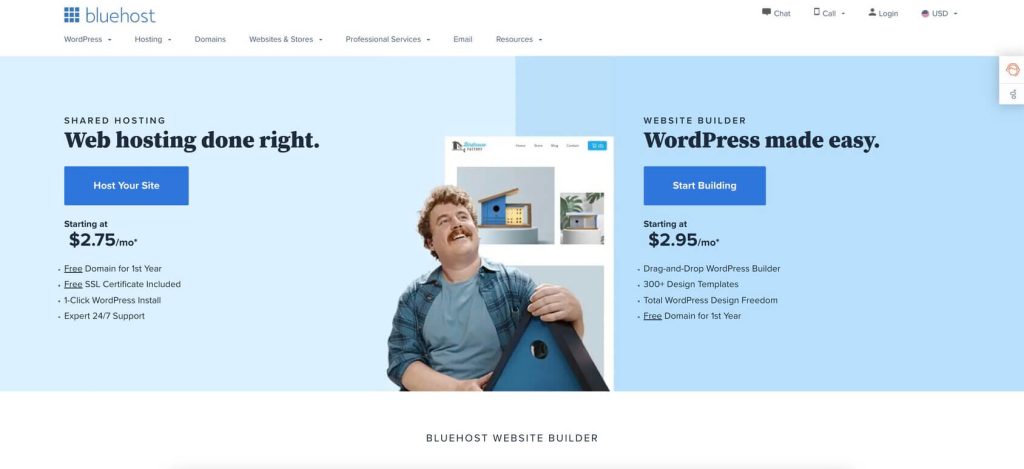
Step 1. Visit the Bluehost homepage
Go to the Bluehost.com website. Then, click the green “Get Started Now” button.
Step 2. Select your hosting plan
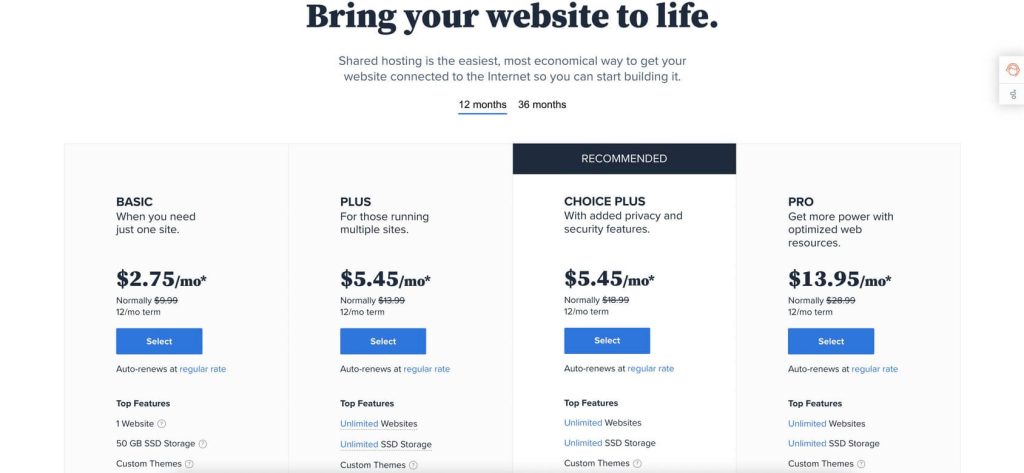
You will start by picking a hosting plan. If this is your very first blog, you can go with the Basic plan. Later, you can easily upgrade to a Plus or Choice Plus plan once your blog starts growing. Explore what each plan offers, e.g. Choice Plus plan comes with Domain Privacy and some extras.
Step 3. Set up your domain name
Your domain will be your blog’s address, so you should take your time to come up with something unique and memorable. Just type your desired name into the “new domain” box and Bluehost will show you whether it’s available or not. If not, it will provide you with a list of similar names to choose from.
Don’t worry if you can’t find a good name right away. You can skip this step and pick a name once you start a blog.
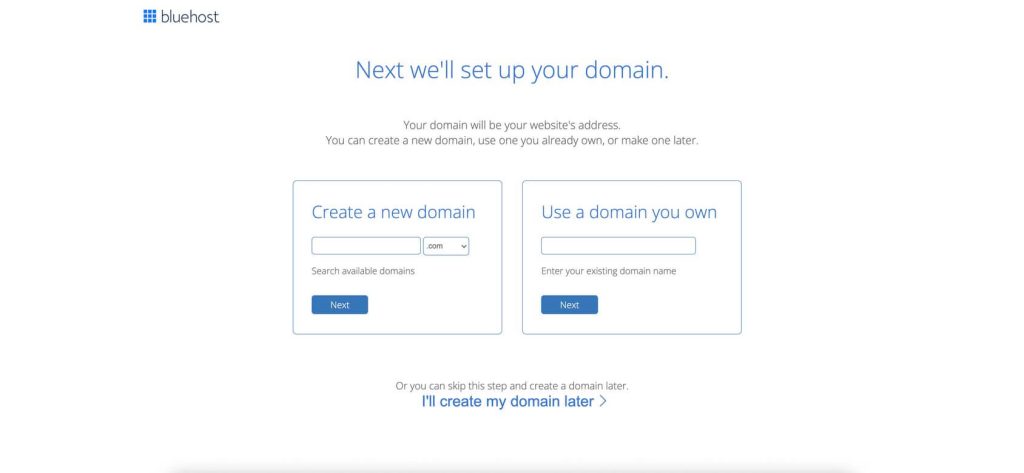
If you have already purchased a domain name somewhere else, you can use that name. Just type it into the “Use a domain you own” box.
Step 4. Register with Bluehost
After you choose your domain, Bluehost will take you to the registration page where you can manually fill in your personal info, or you can Sign in with your Google account to make the process even easier!
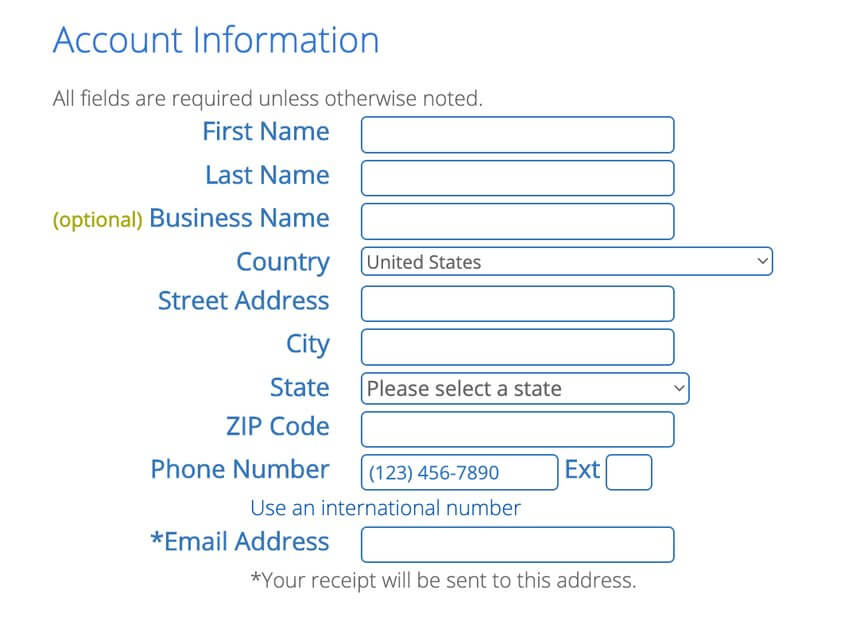
Add your account information
Start by filling out your personal information.
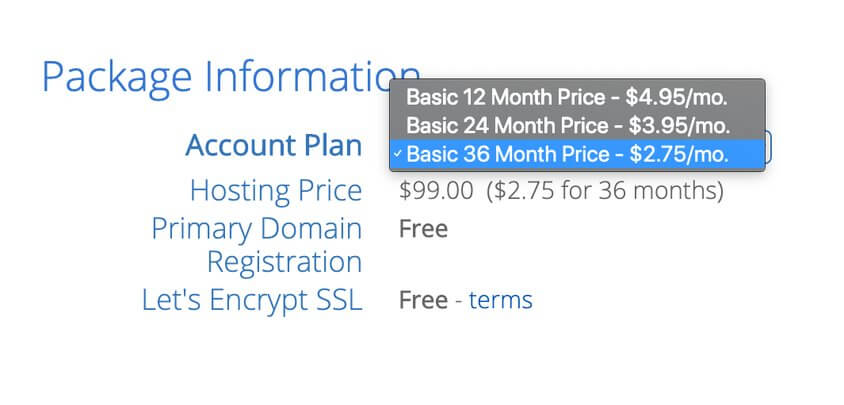
Select your hosting package
At this point, it’s time to select an account plan from the available options. Bluehost offers 12, 24, and 36-month packages.
With a 12-month package, you will pay a lower amount upfront, but with the other two packages, you will get a better deal if you are ready for a longer-term commitment.
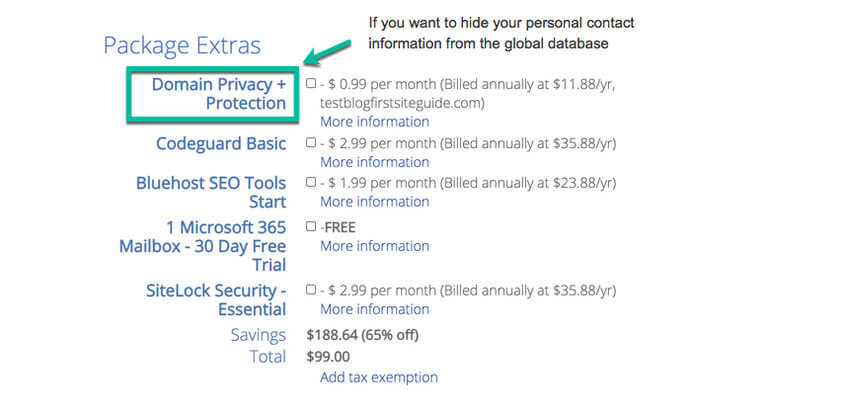
Package extras
Review your package extras carefully. Not every extra is essential, and by unchecking the boxes of extras that you don’t need, your total amount owing will decrease.
You can always add extras later if you find that you need them. I do suggest that you keep the Domain Privacy Protection box checked. This service will hide your personal contact information from the global database, which is publicly visible to anyone on the internet.
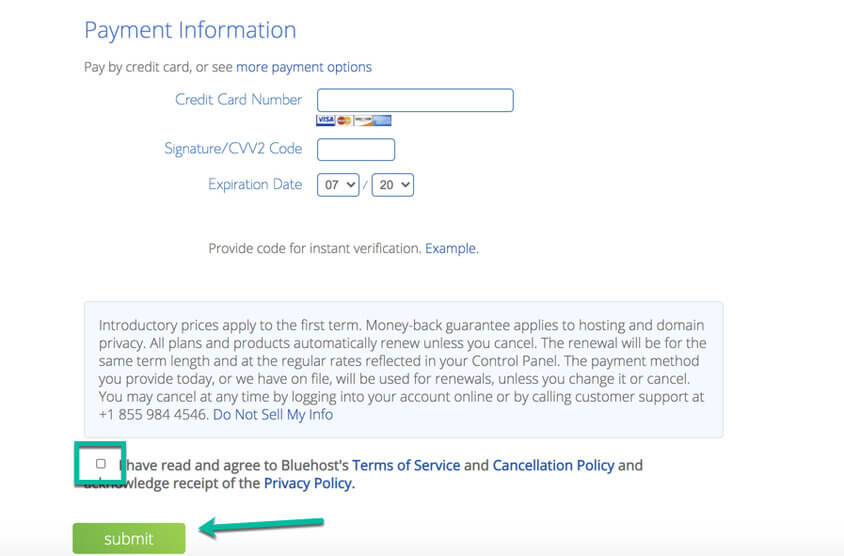
Payment information
Now, enter your payment information. Check the box that you have read and agree to the TOS (Terms of Service), and click on the green “Submit” button.
Bluehost will send you a confirmation email when your payment goes through. You will also receive an email to verify your email address to activate your domain.
Next, you will set up your Bluehost account. You are one step closer to starting a blog!
Step 5. Create your account
Let’s create your account with Bluehost.
- Step 1. Click the “Create your account” button.
- Step 2. Enter your password and complete the account set up.
- Step 3. Your account is ready to go. Click the “Go to login” button.
- Step 4. Fill in the fields “Email or Domain Name” and “Password”.
You are all set. Next, you will start working on creating your blog.
Step #4: Start A Blog By Setting Up WordPress
Once you log in to your web hosting account, Bluehost will offer a 4-step process to help you create a blog. I suggest that you go with this procedure if this is your first time starting a blog.
You can also click the “Skip this step” button and work on blog construction on your own inside your Bluehost hosting account.
Four steps blog set up assistance process:
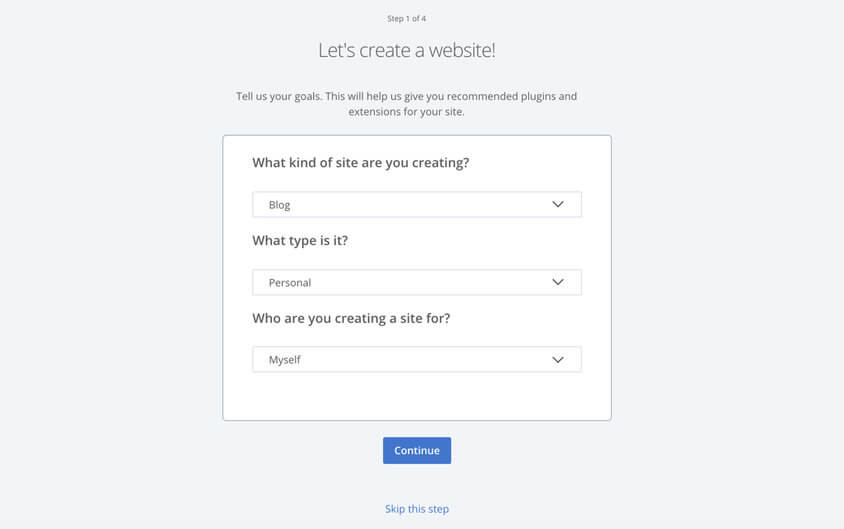
Step 1.
- You will start this process by answering 3 questions: What kind of site? What type is it? And who is it for? In my example, I selected: Blog, Personal, Myself. You can select the same choices or pick what fits your individual case.
Step 2
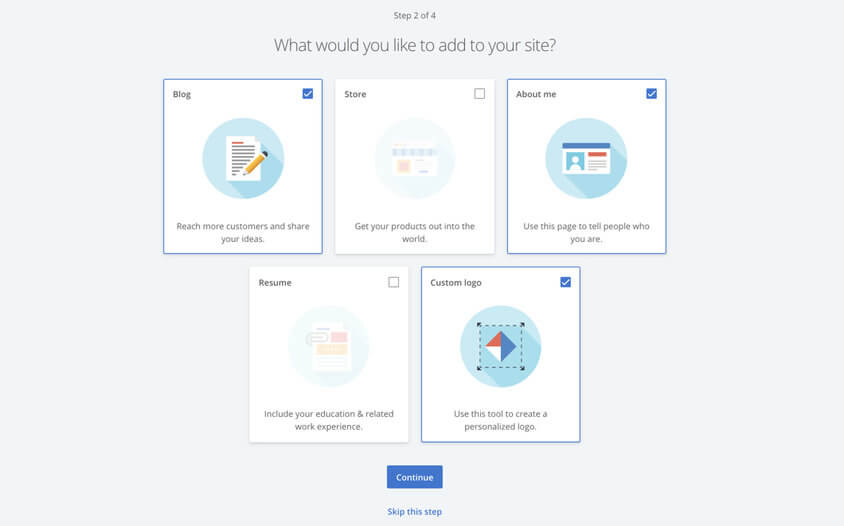
- With this step, you can choose what else to add to your site. Bluehost gives you a few options to choose from.
Step 3
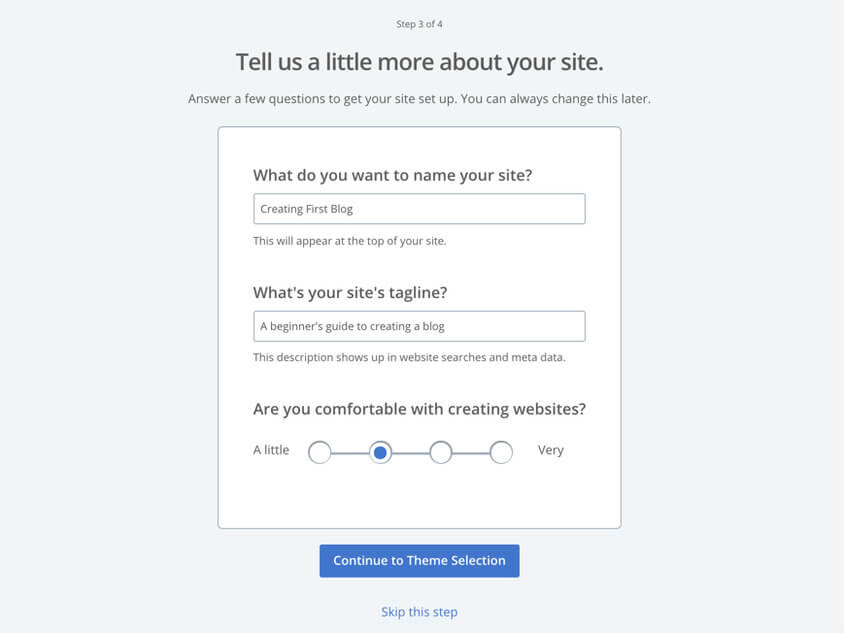
- In this step, you need to answer a few questions such as the name of your blog, tagline, and how comfortable you are with creating websites. Note: you can always change this later.
Step 4
- Check out the suggested themes from Bluehost and see if you like any of them (if you don’t see a theme you like, skip this step). You can always change your theme and use a different one later. More information on this further on.
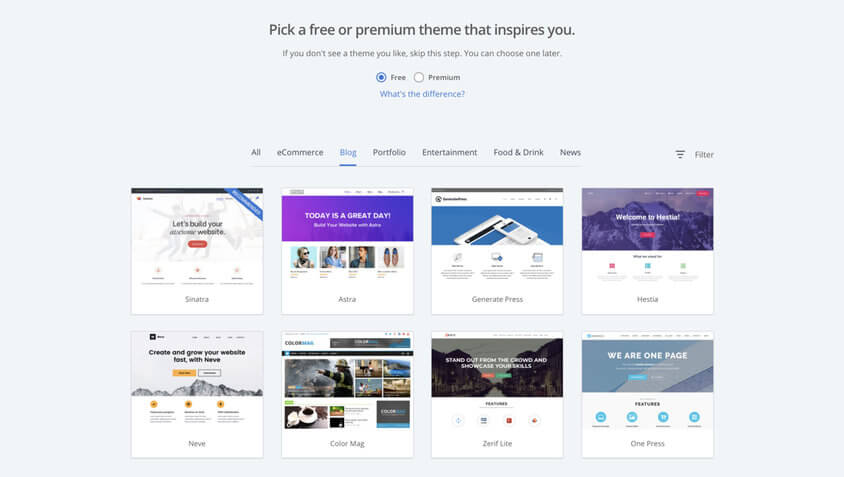
Once you finish setting up your blog with these 4 steps, you will be taken to your Bluehost account page. At this point, the WordPress software is installed and your blog structure is set up!
Launch your blog
Inside your Bluehost account, you can customize your WordPress blog site further based on Bluehost’s recommendations. These options are here for you to do some pre-launch customization to your blog.
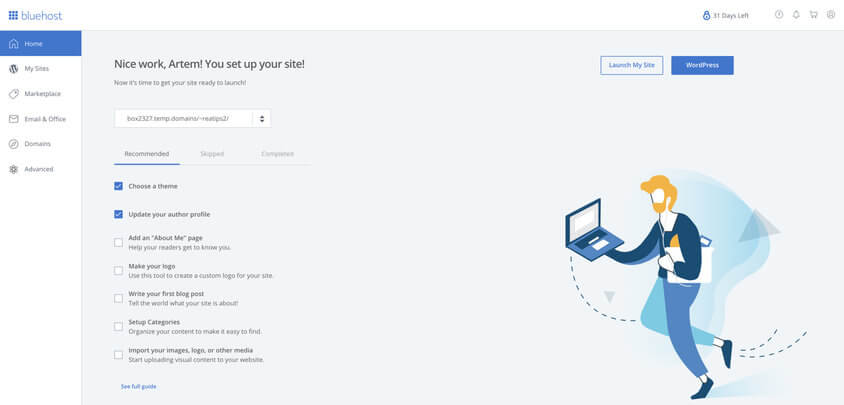
Your blog will go live after you click the “Launch My Site” button!
If you open your website in a web browser, don’t get frustrated if it doesn’t look quite right. This is just the first draft. Inside the WordPress dashboard, you will have to apply a few changes and add some content to make it look polished and complete. I will show you how to do this later!
You can access the WordPress blog dashboard from your Bluehost account by clicking the blue “WordPress” button in the top right corner of your screen.
Did you start a blog yet? → Click Here to Get Started
Next, as promised, I’ll show you how to find the right theme for you, and how to customize your blog.
Step #5: Select a Theme And Design Your Blog
Your blog first needs a face (design and layout).
Installing a new WordPress theme is exciting and fairly straightforward.
Inside the WordPress dashboard, under the “Appearance” tab, click “Themes”. You will be presented with some popular options. You can click on the WordPress.org Themes button and search for free themes. There are more than three thousand themes available on WordPress.org.
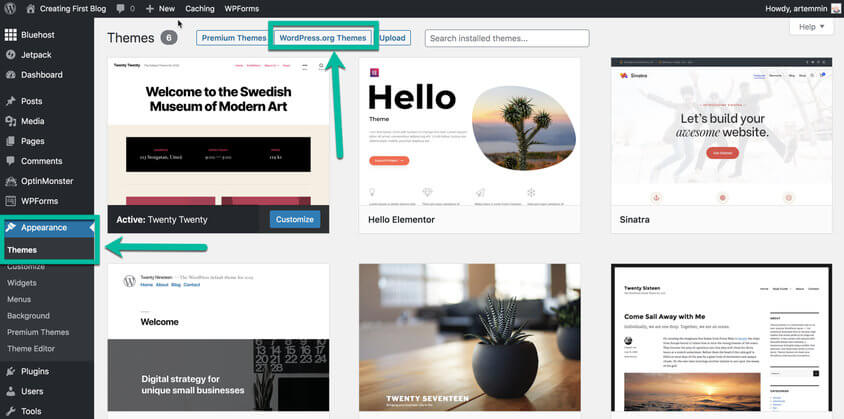
The look and feel of your new blog rely on the theme you choose. Your first-time readers will notice its overall appearance before they even look at the content. Select a theme that looks great, but also works for your specific needs.
Here’s a quick guide for choosing your theme by searching within the WordPress dashboard:
Read the description
- Most themes have a short description of features and functionality. Reading it can help you to figure out if the theme matches your needs.
Preview the theme
- Preview the theme (demo) to get an idea of the overall look, layout, and how customizable it is.
Check the ratings
- Star ratings will be visible in the preview and under theme details to give you a clear idea of how good the theme is.
If you can’t find a theme that you absolutely love, don’t worry. Settle on one that you like, and you can always change it in the future.
Once you install a theme, don’t be surprised if it still doesn’t look quite right. It is just a skeleton of a blog. You’ll have to fill it in with content (text, photos, videos, etc.) to make it appealing.
Should You Choose A Free Or Premium Theme?
I think there are more than enough free WordPress themes to choose from for any blog topic.
If you don’t feel like searching through thousands of themes, you can easily start things off with either Twenty Twenty or Twenty Twelve themes. Both free themes are presented by WordPress.org and are popular with creators.
Remember, you can always pick a different theme later as you continue setting your blog. All the pages and unique content you create will be transferred automatically to a new theme layout.
If the current stash of free themes does not satisfy your desire, you can check the premium themes available. These themes are usually designed by third-party companies and sold on different WordPress theme sites. The price range for single-use licenses ranges from $30 to $500, depending on which premium theme you choose.
Blog Theme Customization
Customizing your blog’s theme is the first step in making it truly yours. Your WordPress dashboard is where you’ll manage your entire blog, from design tweaks to functionality upgrades. While WordPress offers endless customization options, I’ll focus on the key changes every beginner should make. For this guide, I’ll use the Twenty Twenty theme as an example to help you get started quickly and easily.
Make your blog’s logo
You can find the “Make your logo” tool in your Bluehost account. If you didn’t do it while launching your blog, now is the time to finish it.
Once you click the checkbox, you will be taken to an AI-powered logo maker. It’s an easy-to-use tool that you can use to create a beautiful logo for your blog in seconds. Start by entering a name and slogan (if you have one), the tool will automatically generate different types of logos.
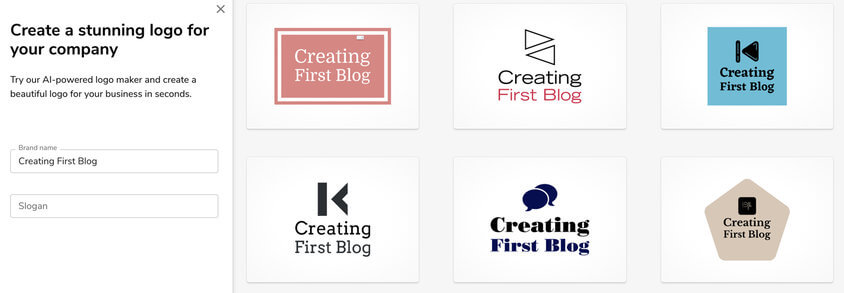
Select one logo you like the most, click on it, and further customize it according to your taste.
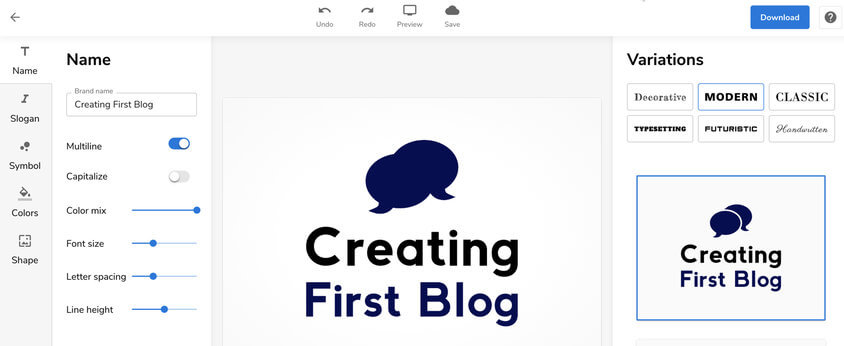
When you are done with your logo design, click the Download button and a new page will show up with your logo files ready to be saved to your computer.
Customize your blog
Getting your blog to look and feel just right is key to making it stand out. In this section, I’ll walk you through the essential customizations—like uploading your logo, tweaking your blog title and tagline, adjusting colors, and setting up your homepage.
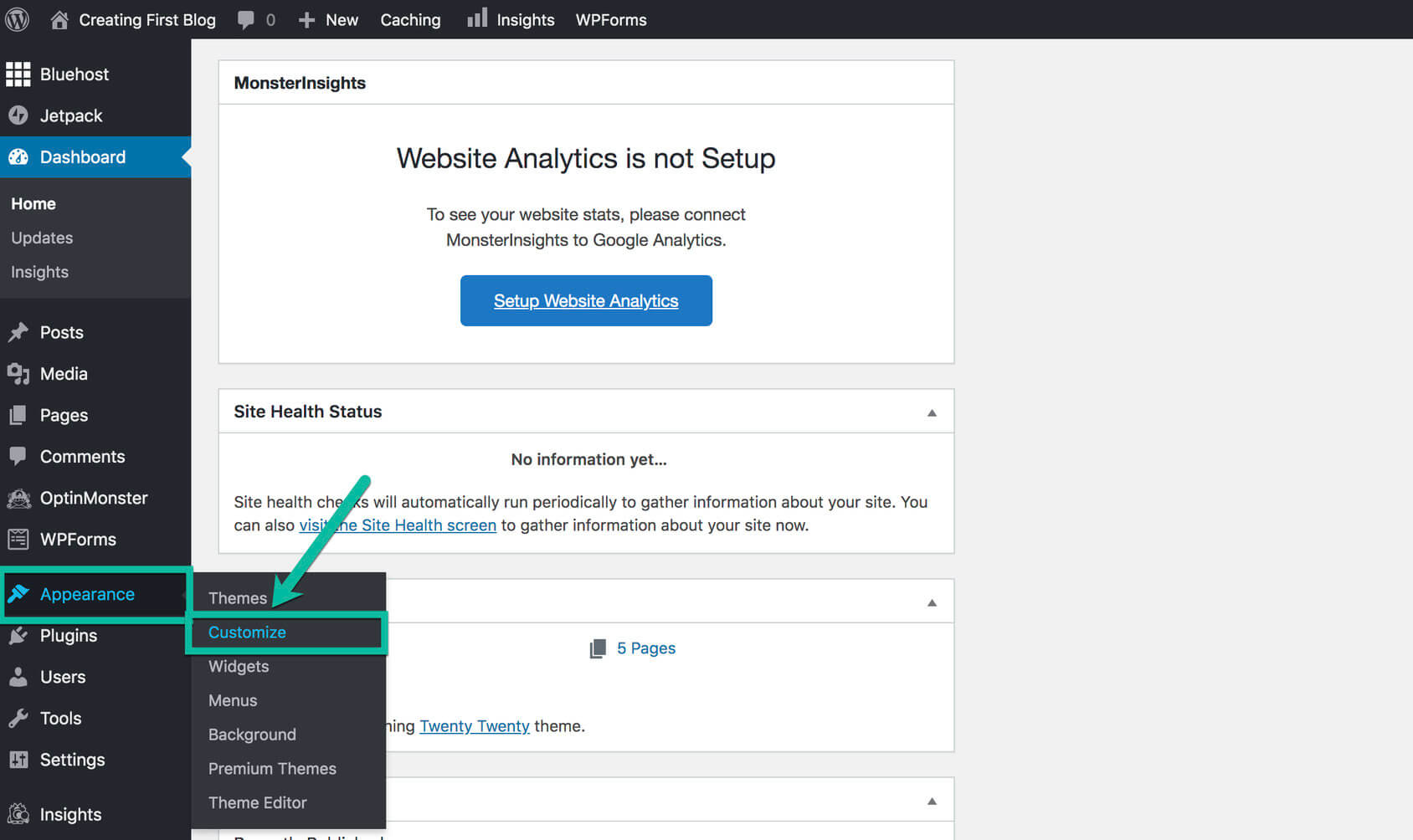
To help get your blog looking professional, head to your WordPress dashboard, find the Appearance tab, and click Customize. If you’re using a different theme, the options might vary slightly, but most themes offer similar customization features. Let’s make your blog truly yours!
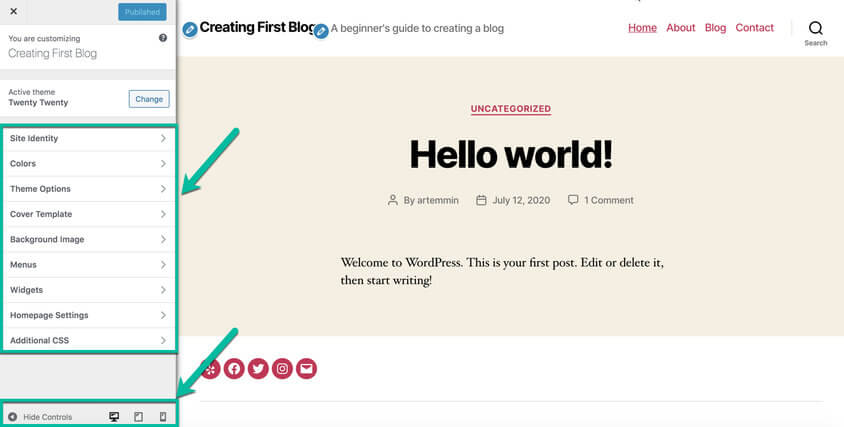
Each WordPress theme will customize a little differently. In my case, I’ll show you the customize options for the Twenty Twenty theme.
On the left-hand side, you will see the following Customizing menu options:
- Site identity – Upload your logo, change site title and tagline, and upload site icon.
- Colors – Change your blog’s background color, header, and footer colors, and customize the primary color.
- Theme options – Select if you want to show a search icon in your blog’s header and show an author bio for your posts.
- Cover template – Make additional changes to the page template such as the overlay background color, overlay text color, and overlay opacity.
- Background image – Upload any custom background image you want to start using on your blog.
- Menus – Customize your blog’s menu, social media menu links, and change the locations where they are displayed.
- Widgets – Customize your footer, add a description, and how to find you if you have a physical location.
- Homepage settings – Choose what’s displayed on the homepage of a blog. It can be the latest blog posts or a static page.
- Additional CSS – Add your own CSS code to customize the appearance and layout of your site (advanced option).
You can also check how your blog looks on different devices by using the menu at the bottom with three icons: desktop, tablet, and mobile devices.
Many themes (e.g. the Twenty Twenty theme) come with the new Gutenberg editor that revolutionizes the way users build pages and write posts inside WordPress.
Want your blog to stand out? With WordPress, you’ll have your blog looking exactly how you want by choosing a theme and tweaking its design. Many themes, like Twenty Twenty-Four, come with the Gutenberg editor—a simple drag-and-drop tool that makes customizing your blog effortless.
You can easily add and arrange blocks for text, images, and videos to create a layout that fits your style. Plus, the preview option lets you see how your blog looks on desktop, tablet, and mobile before publishing.
Add plugins to your blog
Want your blog to stand out? With WordPress, you’ll have your blog looking exactly how you want by choosing a theme and tweaking its design. Many themes, like Twenty Twenty-Four, come with the Gutenberg editor—a simple drag-and-drop tool that makes customizing your blog effortless.
You can easily add and arrange blocks for text, images, and videos to create a layout that fits your style. Plus, the preview option lets you see how your blog looks on desktop, tablet, and mobile before publishing.
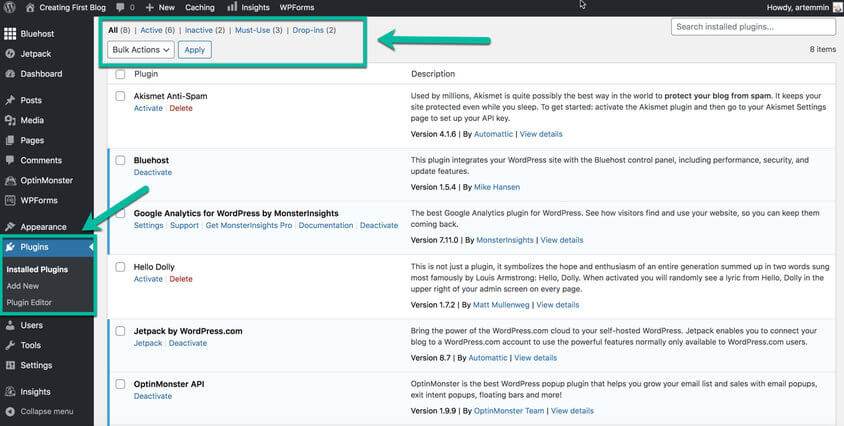
Here you can install new plugins, deactivate, delete, and update them.
Below, I’ll show you some suggested plugins that you should be using.
List of recommended plugins for bloggers
To save you time, I’ve selected some important plugins (free) for your immediate blogging platform needs:
- MonsterInsights – Google Analytics plugin for WordPress to monitor and analyze your website traffic.
- Yoast SEO – A comprehensive SEO plugin for your blog, to optimize your content for search engines.
- WP Super Cache – Helps with the load time of your WordPress blog and delivers content to your readers faster.
- Akismet – Protects your comments and contact form from spam and prevents your site from publishing malicious content.
- Contact Form 7 – A contact form with flexible email options. It supports CAPTCHA and Akismet spam filtering.
- Disqus – An alternative to the basic WordPress comment system with advanced administrative and comment capabilities.
- YARPP – Creates a related blog posts list at the end of each piece of content automatically to encourage people to continue browsing your site.
Congratulations, you just learned how to customize your blog and make web design changes!
The next step is to learn how to write content for your blog.
Step #6: Write And Publish Blog Content

Once you’ve set up your domain, hosting, and blog theme, it’s time to bring your site to life with content. Writing a blog post is where you share valuable insights, experiences, or ideas that attract and engage readers. To start a blog and make it successful, your content should be clear, informative, and engaging.
WordPress CMS is structured in a way that you can publish your content as Posts or Pages.
Before you begin publishing posts (day-to-day writing) on your blog make sure you fill in all the important static pages with content (such as About us, Contact, etc.). Let’s explore those types of pages.
Prepare and publish content on main pages
Depending on your individual needs you can decide what pages to publish. The following are the most common pages bloggers use:
Homepage –
- This depends on what type of layout you choose. As I described above, when customizing your blog you can choose to display the homepage as a static page. In that case, you will have to prepare content for it.
About us –
- The most traditional page on any blog is the “About us” page. This page tells new visitors what it is all about, who you are and why you run a blog about your niche topic.
Contact –
- This page allows visitors to your blog to communicate with you. It can be a straightforward page with your email address plus your social network links, or you can use a simple contact form that visitors can use to communicate with you.
Products, Services, Resources –
- Static landing pages with any additional information that you want to include on your blog.
The guidelines to publish a new WordPress page:
A blog page provides static content or information to the readers. Standard pages that bloggers use include: About, Contacts, Products, or Services. A page also can be a cornerstone (or evergreen) content with information that continues to be relevant to its readers. For example, this guide you are reading right now.
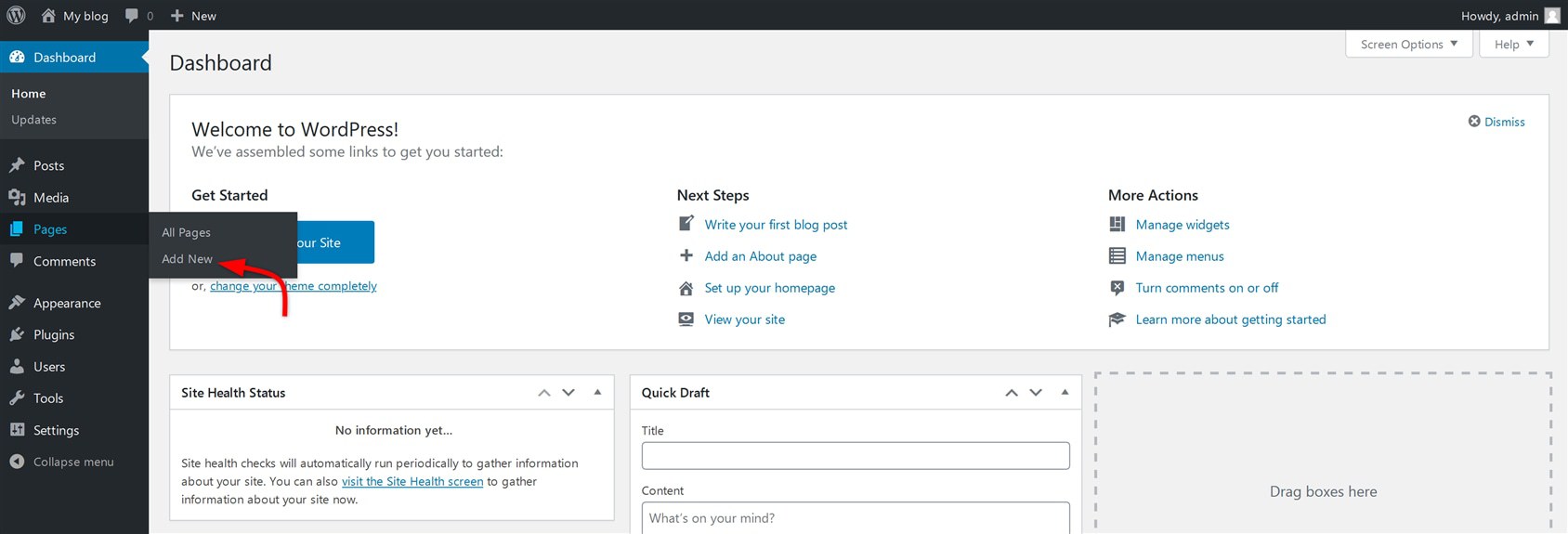
- To create a blog page, log in to your WordPress dashboard admin area using your login details (username and password).
- Hover your cursor over the “Pages” menu item on the navigation menu located on the left-hand side of the Dashboard. Click “Add New”.
Write Your First Blog Post
Creating blog posts inside WordPress is nearly the same as creating pages. However, for a blog post WordPress lets you select categories and tags while pages don’t.
Wondering how you can write quality blog posts? It’s simple.
Here is a simple 3-step approach to making great content of any type:
- Point – State your main blog topic idea that you are covering.
- Prove – Give an example of the idea you are covering.
- Perform – Give a simple way to execute the idea.
The guidelines to publish a new WordPress post:
In your first blog post, you can take a moment and introduce yourself. Tell your readers who you are, what motivated you to blog, and what you will write. The title of the post could be “Welcome to my blog”.
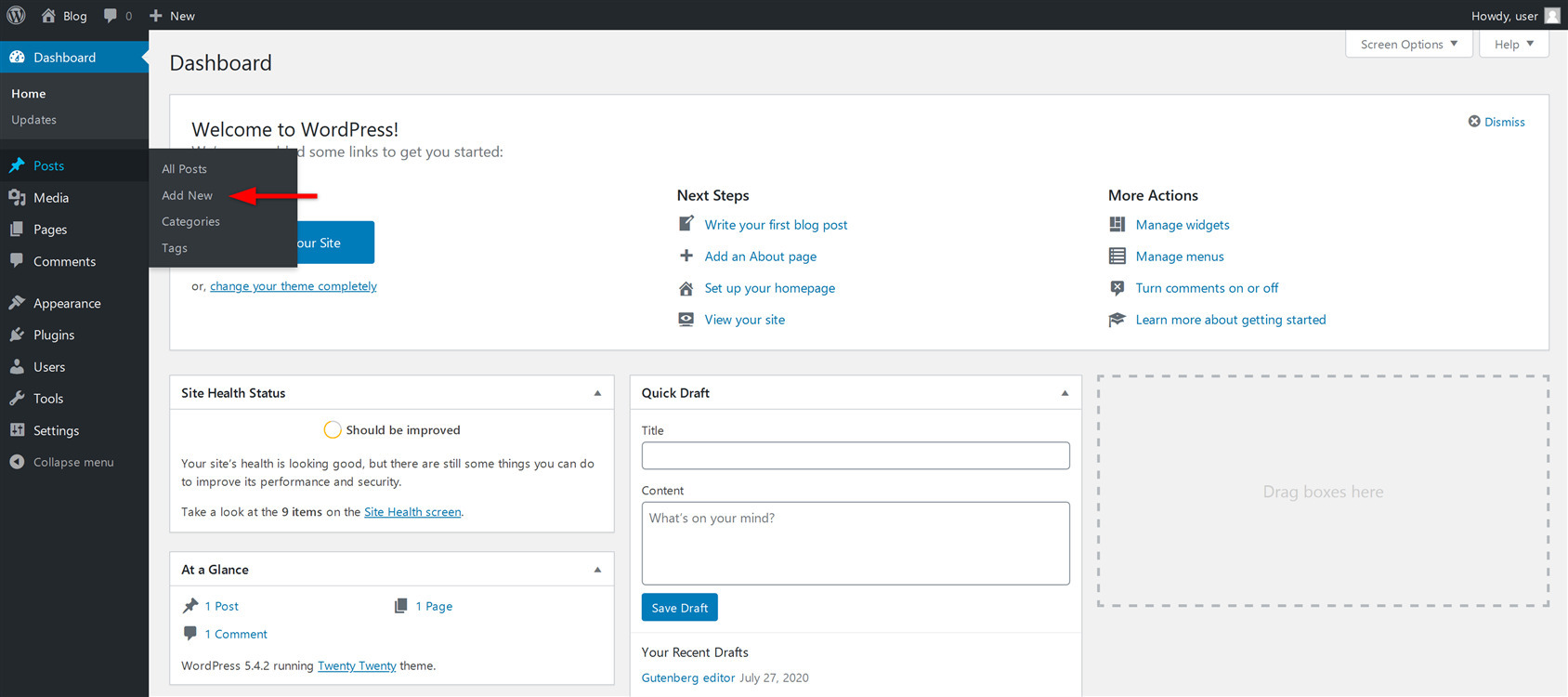
- Inside the WordPress dashboard on the left side, you will see Posts menu item.
- Hover your mouse cursor (or click) on the Post item. Then select “Add New”.
Next, I’ll talk about how to optimize your content for search engines.
Step #7: Optimize Your Blog For Search Engines
SEO helps drive traffic to your blog by making it easier for people to find your content on search engines. Recent data shows that over half of website traffic comes from organic search [.pdf], proving how important it is to optimize your blog.
To improve your blog’s visibility and grow a successful blog, focus on these basics for every new blog post:
- Use Keywords Wisely – Add relevant keywords naturally to match what people are searching for.
- Optimize Meta Tags – Write clear and engaging titles and descriptions to boost clicks.
With these simple steps, your blog can reach more readers and stay competitive online.
Keyword optimization
To get your blog up and running and ensure it gains traction, you need to focus on keyword optimization. This means researching and using the right keywords that your target audience is searching for.
By naturally incorporating these keywords into your blog writing—titles, headings, and content—you improve your chances of ranking higher in search results. The better your optimization, the more visibility your blog gets, helping it grow faster and reach the right readers.
SEO meta tags
When you publish a new blog post or page, you will need to add SEO meta tags for each piece of content.
These are the SEO title and SEO description tags. These tags are not seen on the actual page, but Google will use metadata to better understand what the webpage is about.

If you want to start ranking your content in search engines, this is an important step to complete. SEO tags should be prepared and added when you create a new page or a post inside WordPress. You can add SEO meta tags via free plugins, such as Yoast SEO.
The title tag length should be between 50-60 characters (this is what Google typically displays) and the meta description tag can be between 50-160 characters.
Step #8: Promote, Market, And Grow Your Blog
Starting a blog in 2025 is a great way to share your ideas, build an audience, and even generate income. But simply creating content isn’t enough—if no one finds your blog, all your hard work goes unnoticed. That’s why promotion is key.
The 80/20 rule still applies: spend 20% of your time creating content and 80% promoting it. This is especially important for beginners looking to drive organic traffic. From SEO strategies to social media marketing, you need the right tactics to get readers back to your blog. In this section, we’ll cover the best ways to market and grow your blog effectively.
Before you start promoting your blog, check if it’s ready:
- Make sure that your content is live and ready for promotion.
- Test your blog on different devices (desktop, tablet, mobile) and browsers (Chrome, Firefox, Safari, and Microsoft Edge) to check that pages open correctly.
- Check your contact info and test your contact form to see if it works well.
- Test your social sharing buttons so that people can easily share your content.
- Ensure that you interlink your content so that people can easily find other important information on your blog.
- Give your visitors one or more ways to connect with you and subscribe to your email list.
- Set up Google Analytics to track your blog’s performance and visitors.
Let’s look closely at the basic promotion and marketing activities that you can apply to grow your audience once you build a blog.
Let Everyone Know About Your Blog
Get started by informing your friends, family, and colleagues about your new endeavor. Basically, you should let anyone know who might be interested in reading your content.
You should also do the following:
- Include your blog name (URL) in your email signature.
- Include it in your social media accounts or any online communities you are involved in.
- Use every opportunity to get the word out about your new undertaking.
Be Active Within Your Niche
Get active on relevant blogs, forums, groups, and social pages.
Blogger communities are a good way to connect with other bloggers in your niche. You can engage, build friendships, and help each other in spreading content.
Here are some popular activities you can do:
Blog commenting
Start posting comments on other relevant blogs. It’s a great way to build relationships with top bloggers within your niche.
Social media marketing
You should make use of the social media avenues that best fit your own niche and style. Choose the one (or ones) that best fit your needs and start promoting your content to grow your audience. Some of the most popular social media networks that bloggers use on a daily basis are Facebook, Instagram, and Pinterest.
Guest blogging
Take the relationship a step further and offer to write guest blog posts for another website. Just be sure that you guest post on reputable sites and that the content is directly related to your niche. Guest posting is an excellent way to build an online presence.
Promoting Your Content Through Other Platforms

To expand your blog’s reach and attract a broader audience, it’s essential to promote your content across various platforms. Utilizing a diverse blog content strategy not only enhances visibility but also encourages readers to come to your blog for more insights. Here are some effective techniques to consider:
Bookmarking sites.
- Submit your blog content to bookmarking sites that can offer your content to a lot of potential viewers who are searching for information within your niche. You should do this every time you publish a new blog post to spread the word. Here are some popular social bookmarking and content curation sites: Scoop.it, Reddit, Flipboard, etc.
Content republishing
- You can publish the same or slightly repurposed content on platforms such as LinkedIn and Medium. It’s best to publish content on your blog first, wait a few days while it gets indexed by search engines (Google), and then you can start posting it on other platforms. Also, make sure to link back to your original article as a source. You can learn about a republishing strategy here.
Repurpose content
- You can repurpose your content, create graphics, slideshow presentations, audio files, or even videos and publish it all on the platforms that support different content formats. Here is how you can make 64 pieces of content in a single day (PDF).
Getting Organic Traffic From Search Engines
By now, you already know that it’s important to optimize your content for search engines but this goes beyond just Google.
In order to increase your organic traffic, you will have to learn how to get your content to rank higher in search results among different search engines, with Pinterest growing rapidly in popularity among niche site owners recently.
Google’s many updates have changed how bloggers promote their sites and we should all be focusing on creating varied streams of traffic.
There is no magic formula for higher rankings on any platform, but you should focus on the following factors:
- Create useful content for your readers, not search engines.
- Consistently create fresh and quality content.
- Make sure that the user experience is flawless.
- Ensure that your blog is secured (HTTPS), mobile-friendly, and loads quickly.
- Interlink your content and work on getting external links.
Advertising on the web (paid traffic)
Appropriate and well-informed use of paid media can help you to gain exposure and attention before your organic (naturally derived) traffic takes hold.
Paid traffic avenues include:
- Social media advertising on Facebook, Instagram, Twitter, etc.
- Search engine advertising via Google Ads, Bing Ads, or Pinterest Ads.
- Content discovery platforms such as Outbrain or Taboola.
Remember that you can always find other ways to promote your new blog.
Start Building Your Email Subscriber List
After starting a blog, you will begin attracting new readers and visitors. It’s a good idea to collect the email addresses of those who want to be notified when you publish new blog posts or share promotional offers. As people come to know and trust you, they will respond better to your promotional efforts.
Rely on the blogging fundamentals: a clear and well-functioning blog, focused and helpful information, engaging conversation, and practical advice. Your authority will come from helping and giving advice to your audience.
Step #9: Make Money Blogging (optional)
Monetization is the process of translating your blog activity into earnings.
You should keep in mind that blogging isn’t just about making money. It is about creating useful content and writing blog posts that will attract readers and make them come back for more.
When starting a blog think about adding content that will generate future income. Based on my own blogging experience, as well as from working with other bloggers, I’ve learned that specific kinds of content are more effective for generating money.
Here are types of content that you should consider writing and adding to your blog:
- Listicles or top list
- How-to guides
- Tutorials and manuals
- Product reviews
- Product comparisons
Now, let me show you some different ways how bloggers make money.
Blog monetization channels
Our case study of the blogging industry shows that 59.8% of bloggers make money through blogging.
But, how can YOU make money blogging? There are several options available, but below I’ll show you the best ways to earn income from a blog:
Running ads on your blog
There are seamless possibilities for you to run ads on your blog. Regardless of your niche, you can opt for ads that are specific to what you are writing about or ads that simply better serve your advertiser’s purposes.
Google Adsense, Mediavine, and Adthrive are some of the most popular choices for blog ads.
Enrolling in affiliate programs
Affiliate programs are ways of teaming up with retailers to promote their products and benefit from successfully carrying out sales through a commission.
Some things that you need to consider when enrolling in affiliate programs:
- The number of affiliate sales will strongly rely on the number of visitors you have.
- You need to be credible enough for your visitors to click on your links.
- You may want to consider placing a notice on your Terms of Use page that you do use affiliate links.
There are a few popular online platforms that offer affiliate programs if you want to get started, such as Amazon Associates, ShareASale, and ClickBank.
Selling your products and services
If you are creative and entrepreneurial, you could consider using your blog as a venue for selling your own products and services. This is an option especially as your blog grows in readership, authority, and popularity.
There are WordPress plugins, such as the WooCommerce plugin, that you can easily integrate into a blog and start using to sell products online.
Selling sponsored posts
Collaborating with advertisers through sponsored posts is a proven strategy to monetize your blog effectively. By featuring content that highlights their products or services, you can generate income while providing value to your readers. As your blog’s popularity and authority grow within your niche, advertisers are more likely to approach you with sponsorship opportunities, enhancing your blog’s profitability.
Above are the most popular choices to earn money. However, there are more ways to monetize your blog.
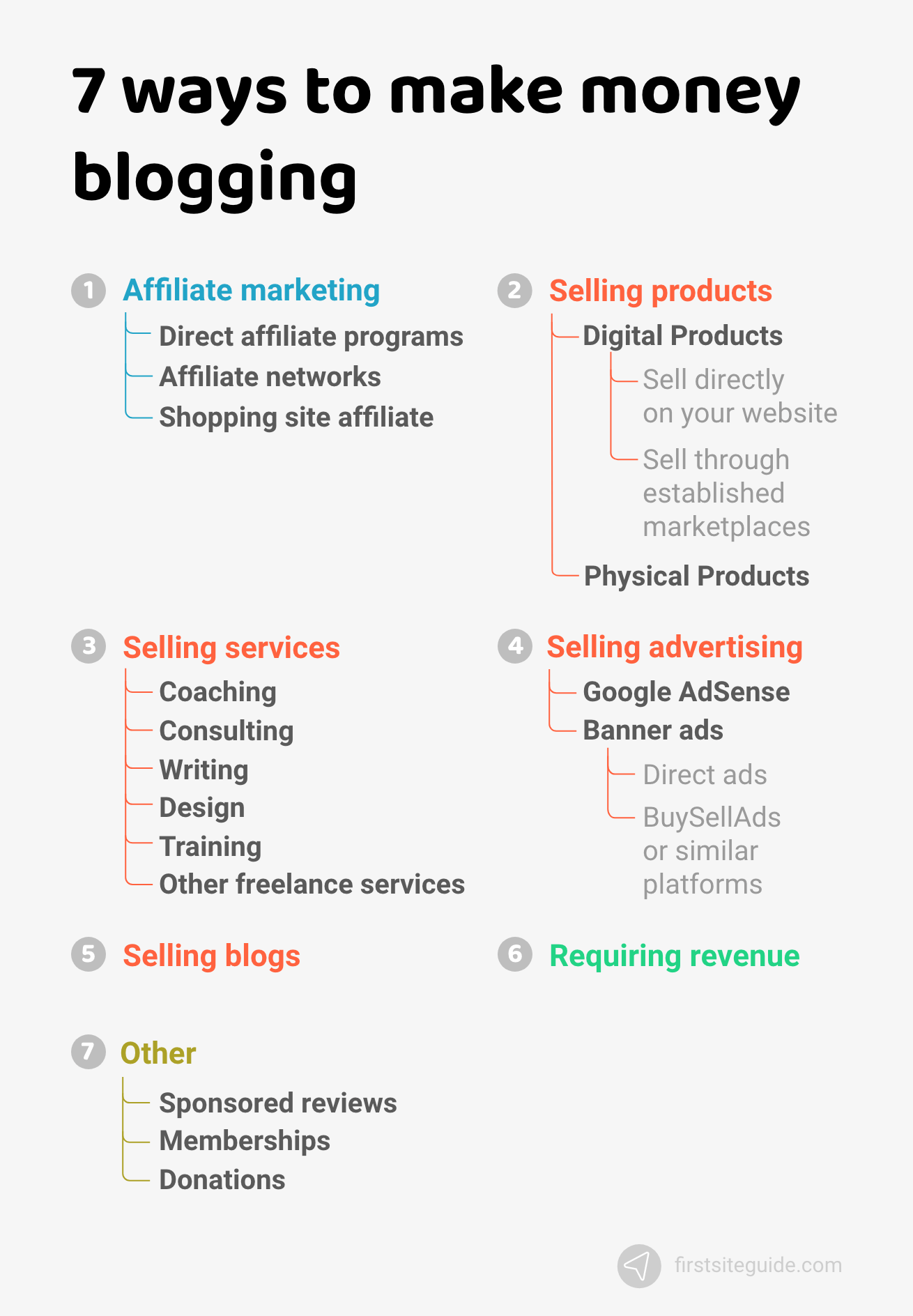
Consider the possibilities, and then choose the method or methods that best suit you and your audience.
As a minimum, you should – from the very start – begin compiling an email list of your readers through subscriptions. Then, when you are ready to recommend products, you will have ready access to those who want to hear what you have to say.
Wrapping Up: Your Blogging Journey Starts Now
Congratulations! You’ve taken the first step to start your blog. Now, it’s time to access your blog, explore the dashboard, and customize it to fit your vision. A blog is a great way to share your expertise, grow an audience, and even generate income. Stay consistent, create valuable content, and promote it effectively. Need more help? Check out our expert resources to turn your blog into a lasting success.
Frequently Asked Questions

Few more things before you get started with your journey. Below are some helpful facts and common questions that many people ask before they start blogging.
thank you, guys, for another great post!
Hi This post is really great! I appreciate all the insights you’ve shared on starting a blog and monetizing it. Your tips on finding a niche and building an audience are particularly helpful. I can’t wait to put this advice into practice. Thanks for the inspiration.
I lik this article Thanks for posting and discussion of the topic start blog, and provide an important information.
Bài viết “Cách bắt đầu một blog trong 9 bước chính xác” là một nguồn tài nguyên vô giá cho những ai muốn bắt đầu viết blog. Bài viết cung cấp đầy đủ thông tin và hướng dẫn chi tiết để giúp người mới bắt đầu tạo blog của riêng họ một cách nhanh chóng và dễ dàng.
Starting a blog and making money involves selecting a niche, creating valuable content, and monetizing through ads, affiliate marketing, or selling products/services, offering a lucrative opportunity for beginners with dedication and persistence.
These guides really help me out. I have been at this for over a year and I’m still a lost duck but I am slowly coming around. Thank you for the great in depth details. They are much appreciated.
Amazing insights for starting a blog, I’m a new blogger and this guide will definitely help me. from UK
I have started habitatmentor.com
KUDOS
Love
thanks for giving us this very useful article!
We’re so glad you found it useful!
Thanks for giving me information. Your article is very helpful for everyone.
Your article is very useful; the content is great. I have read a lot of articles, but for your article, it left me with a deep impression. Thank you for sharing.
We’re so glad to hear that!
Hey there,
I really appreciate the work you have done. You explained everything in such an amazing and simple way.
Thanks!
I really appreciate the work you have done, you explained everything in such an amazing and simple way.
Your post is a valuable resource for aspiring bloggers, and it has inspired me to take the plunge and start my own blog. Thank you for sharing your knowledge and expertise! Keep up the fantastic work!
Glad to hear that. Let me know if you need any help!
Thanks so much. Such an in-depth and step by step guide. Found it really helpful.
I love the itemization of the costs in step #2 so that it’s clear how much it would cost to run a blog. This info makes it helpful for setting up a budget. Thank you.
I really appreciate your effort in writing this post. You may never know how much you inspired me with this guide. I’m definitely giving blogging another shot, and I hope it works this time.
Thanks again!
That’s great news. We wish you good luck with your blogging journey and feel free to contact us in case you need anything.
Hi Anya,
Thanks for the very thorough and in-depth article. There’s never been a better time to start a blog. I would add to your promotion section that you should also use Pinterest as a search engine, not just a social network, as it can be the ideal source of traffic for new blogs.
Best Regards,
David
Thanks David for reading our guide. We agree with you, Pinterest is indeed a very good search engine on its own. It might not be suitable for all blogging niches but is definitely worth using as an additional source of traffic.
Wow! Thanks a lot Anya. This post has been a great blessing to me. I plan to start a sports blog and I will definitely be using the information I got from you. Thanks again.
Thanks Joshua. We’re glad that you find it useful and we wish you good luck with your sports blog!
The information you’ve shared in this guide is remarkable. Thanks for sharing such quality information.
Thanks Julia!
Thank you for this great guide. I have three questions.
1. I’m hoping to start a blog that will require a lot of sports images from a major sports team. I see other local bloggers use Getty Images. Is this easy to do? Is there a cost for that?
2. Also, I want to add a message board and
3. live chat functions.
Are those expensive or hard to integrate?
Thanks very much!
We’re happy to hear that you like our guide, Daniel. Hopefully, it helps when starting your new blog.
Answers to your questions:
1. You can find and use many royalty free and stock photos but if you want to up to date sports images you will need to pay. For example, Getty Images is famous for having images from every major sports event but their monthly plans can be expensive.
2 & 3. You can easily add a message board and live chat functions to your WordPress blog via plugins. It’s easy to install and set up.
I really appreciate the work you have done, you explained everything in such an amazing and simple way.
Is there any other information regarding security? Like preventing people from hacking our website and things of that sort . Also , very concise and informative guide! I wish more guides were like this
Hi there,
Not sure what exact information about the security you are looking for, but here is the guide we have – The Beginner’s Guide to WordPress Website Security.
Hi Anya,
Thanks so much for this post – super useful. Just one thing I’m a bit confused about. If the Bluehost and WordPress are both hosting providers – what is the WordPress you are mentioning within Bluehost?
Sorry if this is a bit confusing but trying to understand it properly
Thanks in advance for your feedback!
Hi Aleksandra,
Sometimes new bloggers get confused. I’ll try to put it simply for you.
1. WordPress.org is an open-source (free) software but in order to use it you need to install it on your own web hosting account. This process is covered in our guide. If you don’t have a web hosting account yet you can use Bluehost (or any other hosting company).
2. WordPress.com is a hosted blogging solution, which means that they offer all-in-one service including hosting and domain name for premium plans. You can check this guide.
Personally, I prefer to use WordPress.org since you get more flexibility that way. But depending on your situation you can go with either option.
Hope I answered your question. Good luck.
Hi,
Thank you so much for such great information.
I have a couple of questions:-
1. How many blog post would you recommend for a new blog before it’s launch.
2. Can you suggest how to come up with new topic ideas? Any step by step method if you can suggest ?
Thank you !!
Hi there,
Thank you for your kind words.
See answers below:
1. You can launch it with one post (or few posts) and keep posting new content. Just keep posting fresh content to grow your blog plus search engines like when new content is added on blogs.
2. Check out this guide -> How to Do Keyword Research for You Blog.
Hope this info will help.
Thanks for sharing such an informational blog which will, surely be a big help to the people who have small medium business.
Thanks John…I hope so too))
Hi Anya,
You have great content on your blog here. Will you be able to tell me if I would be able to add custom javascript/html code to my blogs at Bluehost? Would I be able to export my blogs later should I choose to migrate?
Thanks
Sarthak
Hi Sarthak,
Adding custom code always depends on the theme you choose. Most themes allow you to add custom code to some extent. And for sure, you can always migrate your blog from Bluehost to another hosting provider.
Dear anya,
Thank you so much for this really educational blog, I’ve definitely learned a lot, but I have a quick question, do you think I can start blogging as a college student? I mean, how long doest it take to finish a blog and how many times should i post?
Hi Houmiez,
You can and should start blogging as a college student. The sooner you start the better .
If by finish a blog you mean, how long does it take to launch a blog – you can do it in 20-30 min. Keep in mind that you do need to think about pre-launch content for your blog, such as About page, etc. You can read this guide to get a better idea of what I’m talking about https://firstsiteguide.com/write-content/.
When it comes to blog post frequency it depends on your topic and how much time you have. I would recommend focusing on writing quality content. You can publish blog posts every day or once a week.
Hope this information will help.
Happy blogging!
Dear Anya,
I’ve read this information, which is very educational.
There is no mention of how to have a e-mail associated with the site name, rather than a personal e-mail address (certainly get enough mail there to begin with).
Although you probably know what I mean, instead of “mypersonaladdress@whereever.com” – “mysitenameaddr@mysitename.com” and would the inbox be at the host site, or within my allotted size?
Thanks,
Alice
Hi Alice,
Most web hosting providers offer free custom emails (name@yourwebsite.com) that you need to set up on your own. It depends on your web hosting provider but you should see that option inside your host’s personal account (or cPanel) once you log in to the dashboard.
If you use Bluehost:
Once you have logged into your Bluehost Control Panel:
– Click the Advanced tab from the side navigation menu to the left.
– Click the Email Accounts icon, located in the Email section of the cPanel.
– Click the +Create button and set up your new branded email account.
Once your email account is created you can set it up the way you want to, read this article: https://www.bluehost.com/help/article/email-application-setup
Hope this info helps.
Thanks, this is going to be a very helpful, and relevant guide for anyone looking for informed blogging decisions.
Thanks Robi. I do hope that other people will find it useful too!
Thanks a lot, initially I thought that it would be more complex to start some standard blog, and I was almost in a chaotic situation, but after reading your content I got some handful of ideas. People like you are the ones that I am looking for cause nothing is greater than the valuable words from veterans.
Thanks for such kind words. Good luck with your blog!
This is a detailed blog on blogging in which all the concepts are explained. I was looking for a blog like that, thank you so much for giving such excellent information.
I’m glad that you found it useful Monal. Thanks!
A nice helpful guide for beginners.
Thanks Joseph. Let me know if you need any help with your new blog!
Hi Anya, thanks so much for this wonderful guide! It was so helpful to me! I do have one question: is it possible to secure a domain name so that nobody else can take it, without “publishing” your blog yet or allowing it go live? I would like to secure my domain name, and then hammer out the details of my blog/design the website before letting it go live, but I’m not sure if that’s possible. Thank you!
Also, what is your advice as far as copyright and trademarking your blog or brand goes? Do you recommend doing this immediately or waiting to see growth for your website? Do you recommend copyright, trademarking, or both? Thanks!
Hi Isabella,
In my opinion, you don’t have to worry about copyright and trademarking your blog. We don’t do any of these for our website.
In the United States, you own the copyright as soon as you put the original work on your blog and you won a trademark as soon as you use your name and logo for marketing your business.
However, some people like to use it for certain products and names. You can read our guide – How to Trademark and Copyright a Name or Logo.
Thanks for the kind words, Isabella.
Yes, you can definitely do that. Just go through the process I described in this guide but don’t launch your blog right away. Inside Step #5: Starting a blog on WordPress (Section 7. Launch your blog), you don’t have to click the “Launch my site” button. Instead, you can do pre-launch changes on your blog (design, content, etc.). And launch it when you are ready.
I hope this information will help!
Thanks for this tutorial on starting a blog. I started my blog a while ago but I didn’t understand much about WordPress but now thanks to this information I know more.
Thanks Ronald, glad I was able to help. All the best with your new blog!
Hi Anya! I have a question. I chose a domain name, but that is not what is in the search bar when I am previewing the website. It is a bunch of random words, letters, and numbers. Just wondering if you could help! Thanks!
Hi Sarah,
Your hosting provider has probably assigned you a temporary domain name. It usually takes 24hrs for your main domain to show up.
p.s. sorry for the late answer!
You are a very knowledgable blogger, learned so many things from you. Thank You So Much!
Thanks Zeeshan.
Really amazing Anya! This is a real and complete guide to making a blog from scratch. Very helpful, thank you!
Thanks Marija!
Thanks for your guide.
This is very informative and very simple to start blogging.
You’re welcome Darry!
I’ve read through a lot of “How To Start a Blog” guides and I must say that this one is the most detailed and helpful one I’ve ever come across.
Thanks for sharing this info, it was really helpful.
My friend and I will be launching our blog soon called thefroavenue.com and its all thanks to this guide.
Many thanks!
Thanks Rachel!
Thanks Anya. The guide to starting a blog was well written and easy to understand.
Thanks…glad that you like it!
Hi Anya, that was so informative and clear. I loved your simple language.
Thanks for sharing.
Thansk Harini!
Love the amazing post, keep up the good work.
Thank you Louis!
Thank you for this great content, it really helps.
Thank you for this wonderful and detailed guide. Well done.
Thanks Debby!
This is an excellent guide on how to create a good blog. Thanks a lot Anya for sharing your knowledge.
Thank you Abefe-Balogun! I’m happy that you enjoy my content.
I have read through your Guide for wannabe Bloggers. Quite Impressive, I must say. In spite of the detailed explanations, I still find the process of setting a Blog so complex. I doubt if it is something I can do myself, or will I need an expert to set it for me?
Stanley Moses.
Hi Stanley, the actual process is pretty straightforward if you follow the steps I’ve outlined. You will have your live blog in 15-20 minutes. Keep in mind that after you get your blog online, you need to work on your theme design and content. Feel free to reach out to me via our contact form if you have any questions along the way. Good luck!
A great guide in precise words. I was just thinking about beginning my own blog but had no clue how it works. Thanks for the information conveyed here. It had been a great help.
Thanks Durga! I’m glad that you find all of the steps useful. Let me know how it goes!
Thanks for the guide, easy to learn for a beginner.
Thanks Andy!
Thank you so much for giving me the needed push to get this moving! Your post covers so much information and answers so many questions! Thank you again for sharing.
You’re very welcome Ck!
I am really grateful for this information. It’s so helpful to me as I have been planning to start my own blog for some time now.
I’m happy to hear that Hayinday. I hope my guide will help you get your new blog live. Let me know how it goes and good luck!
Thank you so much for sharing these great tips! I am living in the US now, but will soon return to Brazil. Will I be able to keep my blog running with Bluehost and WordPress? Can I change the payment details later? Do you know if my domain will show up from searches outside the US? Thank you so much again!
Hi Maria. Your blog will work just fine anywhere so don’t worry about it. And with Bluehost, you can always update your payment preferences. All the best!
Thank you so much Anya…This is a very simplified step by step to blogging. I truly want to get started this minute.
I’m happy for you Inetty. Let me know if you have any questions along the way.
Loved your guide. It is super helpful and complete. I do have one question. If you already bought a domain, would you be able to use the hosting service you recommend?
Hi Christine. You can transfer your domain to Bluehost and still be able to use it. When you come to the step of choosing your new domain, just select the option “I already own a domain”. Let me know if you have any other questions!
I really appreciate the content here, thank you so much. Very informative information, easy to understand.
Thanks Desire for your kind words!
Hey Anya,
I hope you are doing well.
This guide on starting a blog is one of the most precise and easy to consume content for beginners. I just started exploring your other content as well and hoping to enjoy it. Be safe and have a nice day there!
Thank you Mudassir! I hope you will enjoy the rest of our content.
This is an excellent guide on how to create a good blog. Thanks a lot, Anya for sharing your knowledge. Really useful!
You’re very welcome Aditya! I hope it helps you start a blog on your own.
I have a question what if I want to write about multiple topics?
Hi Elio! You can certainly write on multiple topics. There are ways to categorize your topics within WordPress.
This was really helpful! The step by step approach was of great help and as a beginner, I got it all clear.
Thanks Mahak! Let me know if you need any additional help. Good luck with your blog.
This is an excellent guide on how to create a good blog. Thanks a lot Anya for sharing your knowledge.
You’re very welcome Grace. I hope it helps you set up a blog. Thanks!
Hi Anya, That’s really a detailed post on how to start a blog and I loved it.
Thank you Niraj!
Thank you. You made it quite simple. As a beginner, this is all we need to know. I got almost all the answers. Thank you again.
You’re very welcome Shree. I’m happy that you found your answers. Good luck with everything.
Hi Anya, I am a novice when it comes to blogging. You have invested a lot of effort and time, to come up with this, “to the point” and “easy to understand” article. I now have a fair idea of what is blogging. Thank you .
Thank you Suresh! I really appreciate it when people recognize the effort…this means a lot to me. Thanks once again.
Wow, this is an amazing guide, keep up the good work.
Thanks a lot Louis…really appreciate it!
Wow! This the best guide ever. I have been wanting to start a blog and now I have an idea. I will start with my research and brainstorming the domain name.
Thank you
Thank you very much for your kind words. Please let me know if you have any questions!
Outstanding post, well done! Couldn’t agree more, your profitable niche is the most important step. Because all keyword and search phrase placement is dependent on that. Without which it will be impossible to dominate search result pages.
Thanks Deon!
This was such a wonderful guide! I’ve been wanting to start a blog for a little while but never knew where to begin. I’m actually excited now and brainstorming a domain name. Thank you for your helpful tips and step by step instructions!
Thanks Shilanda. Let me know if you have any questions and good luck with your blogging!
This is the most comprehensive guide on starting a blog.
Thanks a lot Chandra! Glad you like it.
This was very helpful, thank you! Your step-by-step instructions helped me understand where to start and how to get to where I need to be.
Thanks Samantha!
This is an amazing article that helped me in deciding on how to start my blog. I appreciate the step by step process you went through to explain on how to start for beginners.
Thanks and good luck with your new blog!
Thank you for the information. It is really helpful. Please note you have a small word omission under the sub heading- “Submit your blog to bookmarking sites”.
Bookmarking sites can offer your content …… You should (do) this every time you publish a new blog post to spread the word out. Some popular social bookmarking sites are Scoop.it, Reddit, etc.
Thanks a lot Giovanna! It’s fixed…really appreciate your help.
Amazing! Very nice guide….!
Thanks Rasel! Hope you find it useful.
Your article was very informative and it actually helped me make my decision to start! Thanks Anya
I’m so glad to hear that Angela! Wish you all the best with your new blog.
Thanks for sharing the valuable content!
Thank you Shantanu!
I must confess, I haven’t read an easy-to-implement guide like you have provided here, for a very long time. I’ve always wanted to start my blog and now I’ve found help. Thank you so much!
Thanks Johnson! Let me know if you need any help with starting a blog.
Thanks for sharing! It’s an easy step by step guide for starting a blog. It is very helpful for all new bloggers.
Thank you Kaye! Let me know if you need any help with your blog.
What an incredibly informative article. Im looking to start a blog for my company and i love this article. In fact you are now bookmarked as my blog bible. Any problems i can and will probably run into getting it off the ground you cover. Thank you truly for sharing and helping others take a creative step in the right direction. Im not sure i get evergreen content. I mean i get the gist of it but is it like if i ran a food blog and had recipe for a soup that was popular and people kept coming back for it? Or am i missing the point? Sorry it may be obvious and i am just not getting it.
Thank you Megan for your kind words.
My explanation of evergreen content is this:
Evergreen content is content that continues to be relevant to its readers and gives them value years after the publish date. It remains informative and retains its original quality. As its name implies – it is timeless.
I hope it helps. Feel free to reach out if you need any help!
Thanks for sharing this useful information with us. This is a clear step by step guide for all beginners.
Thanks…appreciate it!
It’s such an in-depth guide on how to start a blog. You have given a clear picture of how to start a blog, hosting services, etc. It will be a goldmine for new bloggers.
Thanks Saurav, I’m happy that you like it! Let me know if you need any help.
This is a well-detailed process of starting a blog, and it will be of great help to me. Thanks for this
Thanks Juliet! Let me know if you need any help with your blog.
Hi….newbie here…
It’s really awesome..and helpful…thank you so much…
It’s such an in-depth guide on how to start a blog. You have given a clear picture of how to start a blog, hosting services, etc it will be a goldmine for new bloggers.
You’re very welcome Sara. I’m glad that you found it useful!
Thanks for sharing the content. This is a very useful guide.
You’re very welcome. Let me know if you have any additional questions!
Thanks Anya. The guide to starting a blog was well written and easy to understand.
I’m glad that you find easy to understand! Feel free to reach out to me if you have any questions.
This is the most detailed guide I have ever come across. Starting a blog is one of the most difficult tasks for newbies because they are always confused to find the right steps. You explained very well to buy a domain name and hosting for the blog. I am happy to see that you recommended one of the most used CMS WordPress in this article.
Thanks for putting this awesome article.
Thanks a lot Kulwant! Happy to hear that you find it useful.
I wish to start my blog very soon. Thanks for this great guide.
Thanks Juliet! Let me know if you have any questions or need any additional help.
Great content, you really explained every single thing in detail. Keep up the good work!
Thanks Samuel! Glad you like my guide.
An amazingly awesome content. A very helpful guide and thank you very much.
Thanks Rohit. Let us know if you have any questions or need some help with starting your new blog!
This is a very useful guide. Thanks for sharing your ideas…
Thanks Harry! I hope it will help you with your blogging journey.
What an amazing guide about the blog. You have helped many people with this topic. Thanks for sharing this information!
Appreciate your support. Thanks!
Keep going and thanks for sharing this information on how to start a blog…
Thanks Anita. Glad you like it!
Thanks for sharing the nice article. I really enjoyed reading it. This is a very good guide for people who want to start up a new blog.
Happy that you like it. Let us know if you have any questions and we will help you for free.
Thanks!
I recently started my blog after procrastinating for so many years, It has always been my dream. This is so comprehensive and it is helping me through the early phase. Thank you so much.
I’m very happy to hear that you like it. Good luck with your new blog and do not forget to check out our other resources!
Hello Anya Skrba, I really liked your cost-effective guide. I now speak to myself, it’s time to start blogging. Let’s get in touch for more guidance, please. Thank you.
Hi Freedman,
Please get in touch with me if you need any help. I would love to help you with your new blog!
Thanks for sharing! It is a very easy step by step guide for starting a blog. Its really very helpful for all new bloggers.
I’m really glad that you find it useful!
Please do not hesitate to reach out if you have any trouble with starting your blog – we are here for all blogging newbies
Hello Anya,
Very Informative post. Your way to guide us is very easy to understand. Thanks!
I’m glad to hear that Rubina!
If you need any additional help on how to start a guide plese do not hesitate to reach out to us at hello@firstsiteguide.com
Great blog!!! Great guide with an excellent idea!Thank you for such a valuable article. I really appreciate this great information.
So glad to hear you find my guide useful Mark! and good luck blogging!
Thank you for reading it
Hi, I have recently started my own blog and these points would help me a lot. Thanks
Awesome article! Starting my own blog has helped me personally in achieving a lot of goals. Apart from the fact that it makes my personal brand quite prominent in my niche it also allows my readers to get useful and applicable information regularly.
Very informative Article. Thanks for sharing…it will help me to start a new blog.
Thank you for the guidelines. They are clear and easy to understand. Now I’m keen to embark on my fashion blog.
Often, when I speak with people who quit blogging, I tend to get answers that revolve around the hardships in the promotion.
I like the tips listed above as they are very efficient promotion methods.
Great article. Blogging is one of the best freelancing options to work from home and make money. Your post covered all important aspects of starting a blog. Well written.
All the best,
After reading some posts about blogging, and finally this, I start wondering if blogging is also meant for poor writers. Here’s my big question: can a ‘poor writer’ start a blog and hire some persons to create content? How bad does this affect new bloggers?
Hi Jane,
Blogging is in fact supposed to help with your writing. The more you write, the better you will get! And of course, you can always hire someone to help you with the content.
Good luck!
I’m a bit scared to be honest…I’m reconsidering if blogging isn’t a bit of a big step for me… Oh, what to do guys? You made it sound like a piece of cake but is it really?
Hi Simon,
I suggest you go over our section “Know why you’re starting a blog” again. I hope it will help you understand the benefits of blogging.
Blogging is extremely intimidating. That’s how I felt, Simon, when I started in 2016. My site, Just Add That, was supposed to be a couponing website. But I didn’t know what I was doing, and I didn’t know where to start. Burn out happened quickly. Off and on for the next year, I tinkered and learned the basics of blogging following articles like this one at First Site Guide.
After learning the ropes, I felt much more confident and continued to build my following and promote my site. Just Add That went from nothing to something in just a few years. Is it work? You bet. Is it worthing? COMPLETELY! Be brave and be bold. You can do it! Good luck, Simon!
Do you really mean that 77% of internet users read blogs? That’s quite a huge audience to tap from! Too bad, I gave up on my blogging career years ago. I’m tempted to give it another shot now.
Choosing a domain should be in line with one’s financial capability and blogging idea, I guess. You wouldn’t want to spend much on renewing your domain plan when you’re yet to earn from your blogging activities.
Blogging appears to be a full-time business for many online entrepreneurs, and they make a good living from it. However, I’d like to know your take on the idea of a newbie blogger going all in, and possibly dropping off a low-paying 9-5.
OMG! 6,7 mill of people are blogging now?! That’s like…wow… I had no idea.
Good idea to point this information in the infographic – the number is astonishing!
I really used to think that starting a blog would cost a whole lot of money. I had a friend who blogs about recipes and I’ll always see her buying stuff, paying for videos and photographs and all that and so I imagined that it was that way with the rest. But I think I understand it better now. Thanks a lot for this simple yet comprehensive guide.
Someone was telling me that I need to have a large number of following before I can be accepted to place ads on my site. I have tons of subscribers but haven’t monetized my blog because I feel I still have a long way to go. After reading this post I have checked some tools and I’m surprised to see that I can do well if I monetize it now.
I used to make and post content on YouTube but honestly, it costs me a lot to make a professional video. Now I’m really thinking of moving to a blog because from this post I can see that it won’t cost me as much as it does with video uploads.
I have a blog which I’ve long forgotten about it because I wasn’t getting traffic as I expected. I’ve always thought I wasn’t cut out for this but right now, I have realized that I didn’t push it out to the public well enough and so I’m going back to give it another go! This has really caused a spark of energy within me.
Thanks for the great article Ogi. I am a great fan of FirstSideGuide’s web design and graphics. Creating a blog isn’t a tough process. The real difficulty is in marketing our website to reach the audience. Though people say you can do that easily with SEO, the competition in each and every niche is damm too big. On the other hand, the low competitive niches have very low traffic volume.
Awesome content! I was looking out for the promotion ideas because I have a blog in Travel Niche but it’s not performing well at all. I’ll have to try paid traffic option. Do you have other promotion ideas you could suggest?
Hi Sandra,
you should check out our guide on blog promotion. Hopefully, you will get some more ideas to help you promote your blog.
Good luck!!
You may never know how much you inspired me with this guide. I’m definitely giving blogging another shot, and I hope it works this time.
Thanks again!
Thanks for sharing this guide. However, you talked about choosing a niche in line with passion and hobbies. Does this make it impossible to choose a niche that “pays” as people would say? Even though it doesn’t dance in tune with one’s passion.
Hi Williams,
You can certainly create a blog to make money off of it. There are various monetization strategies you can apply once you start your blog.
I just really appreciate that you guys covered the costs of starting a blog! This way I know how to manage my budget
Thanks a lot for this!
Thanks for sharing the nice article. I really enjoyed reading it. This is a very good guide for people who want to start up a new blog.
This is an easy step by step guide for starting a blog. All new blogger needs to read this once. I am sharing this on my social media. Thanks for sharing.
Thank you for the great guide. I will use the information provided and pass the word on. Thank you.
What an amazing guide you have shared on starting a blog. I really appreciate your effort in writing this post. Thanks for the great share. I will be sharing it with my new blogger friends.
This will be really effective for me, so thank you.
This is the most comprehensive guide I’ve read so far and I decided to go with it!
I particularly appreciate you guys also covered later development like WP dashboard navigation and content creation and promotion – this helps me a lot with my blog plans!
What are the costs for WordPress.org?
Hi Shawn.
WordPress.org CMS is free. But keep in mind that you need to have a web hosting account to set up a WordPress CMS!
Let us know if you have any other questions. Thanks!
Great information in simple easy language that a non-tech can understand. I was thinking of starting a blog but knew nothing about it as to what to do how to do. Now I know all that is needed to know.
Thanks